

Cabarrus County Schools may be forced to make significant cuts as it works to reduce its local funding request for the fiscal year 2026-27 budget from roughly 8.5% to 4.5%.
To meet that target, the district would need to cut an additional $4 million from its proposed $105 million local operating budget, according to a draft budget amendments plan set to be presented Wednesday by Chief Financial Officer Phillip Penn and Superintendent Dr. John Kopicki to the Cabarrus County Board of Education Finance Committee meeting.
The cuts come after the Cabarrus County Board of Commissioners abruptly halted a planned budget presentation by district officials a few weeks ago, citing concerns that the request exceeded a 4.5% increase over the current fiscal year.
Commissioners not only declined to hear the presentation, but also directed county staff to hold school funding at approximately $102 million, the same level as last year, until further notice.
The public sharply criticized commissioners during last week’s meeting for refusing to hear a budget presentation from CCS. Commissioners, however, defended the decision, saying the 4.5% expectation had been clearly communicated to the district.
“They’ve been informed that 4.5% is all we can do,” Vice Chair Ian Patrick said. “Money is tight.”
However, the commissioners did hear budget requests from Rowan-Cabarrus Community College and Kannapolis City Schools, which is also seeking a local funding increase of about 8%.
As part of the proposed budget amendments, CCS leaders say the original request, an 8.43% increase, reflected months of discussion and a growing list of operational needs identified during public budget meetings.
Like school systems across North Carolina and the nation, CCS is facing rising costs across multiple areas, including employee benefits, utilities, transportation, maintenance, insurance, instructional materials, and school safety.
Officials say these are not optional expenses, but are necessary to maintain safe and effective learning environments.
“Our local funding request reflects sustaining current operations, supporting student growth, and ensuring safe and efficient school operations,” the draft plan states.
Even with those pressures, district leaders say the funding request was designed primarily to sustain current operations, accommodate student growth, and ensure schools remain safe and functional.
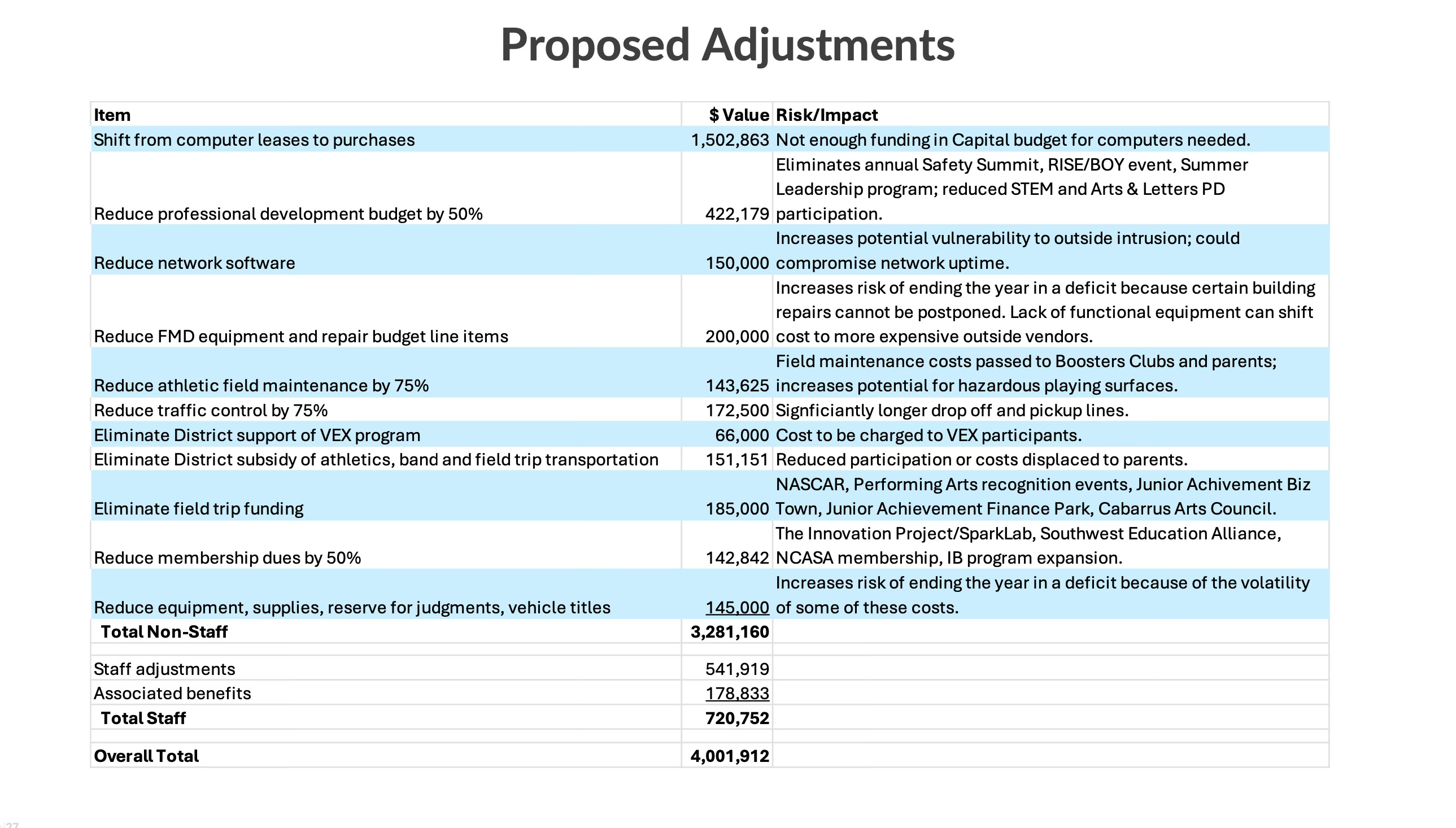
Reducing the request to 4.5%, however, would require an additional $4,001,912 in cuts, on top of reductions already made during the initial budget process.
District leaders say the proposed reductions are guided by several key principles, including protecting classroom-level staff and activities, minimizing impacts on instructional outcomes, and relying on attrition — such as retirements and voluntary resignations — rather than layoffs when staff reductions are necessary.
Some of the key proposed reductions in the draft plan include:
Eliminating funding for field trips, including performances coordinated by the Cabarrus Arts Council
Ending district support for the VEX Robotics program, which provides students with hands-on engineering and competition opportunities. The cost would then be charged to the VEX participants
Eliminating district subsidies for athletics, band, and field trip transportation, shifting those costs to parents
Reducing athletic field maintenance by 75%, shifting more costs to booster clubs and families and increasing the potential for hazardous playing surfaces
Cutting traffic control services by 75%, likely leading to longer drop-off and pick-up times at schools
Reducing the professional development budget by 50%, which would eliminate annual events such as the Safety Summit and R.I.S.E. and limit participation in STEM and Arts and Letters programs
Transitioning from leased computers to purchased devices
Reducing network software, which could increase vulnerability to outside intrusion and compromise network uptime
In addition, CCS will continue to review the budget for any additional reductions, monitor staff turnover heading into the 2026–27 fiscal year, and track any final action by the North Carolina General Assembly on the passage of a state budget.
“Cabarrus County Schools is committed to protecting high-quality learning opportunities for students as the district continues to plan for the 2026-27 fiscal year,” the district told The Cabarrus Compass in a short statement.
The proposed reductions are also expected to be discussed during the school board’s May 4 work session.
More information about the development of the 2026–27 budget is available on the district’s Engage with CCS webpage under “Funding our Destination 27,” where community members can also submit questions about the budget.
I am disappointed in our county commissioners and with the lack of support from Raleigh. As the state wants to have more and more control of things, this pushes costs to the counties who are struggling. The lack of funding for required services is hurting our counties and our state.