

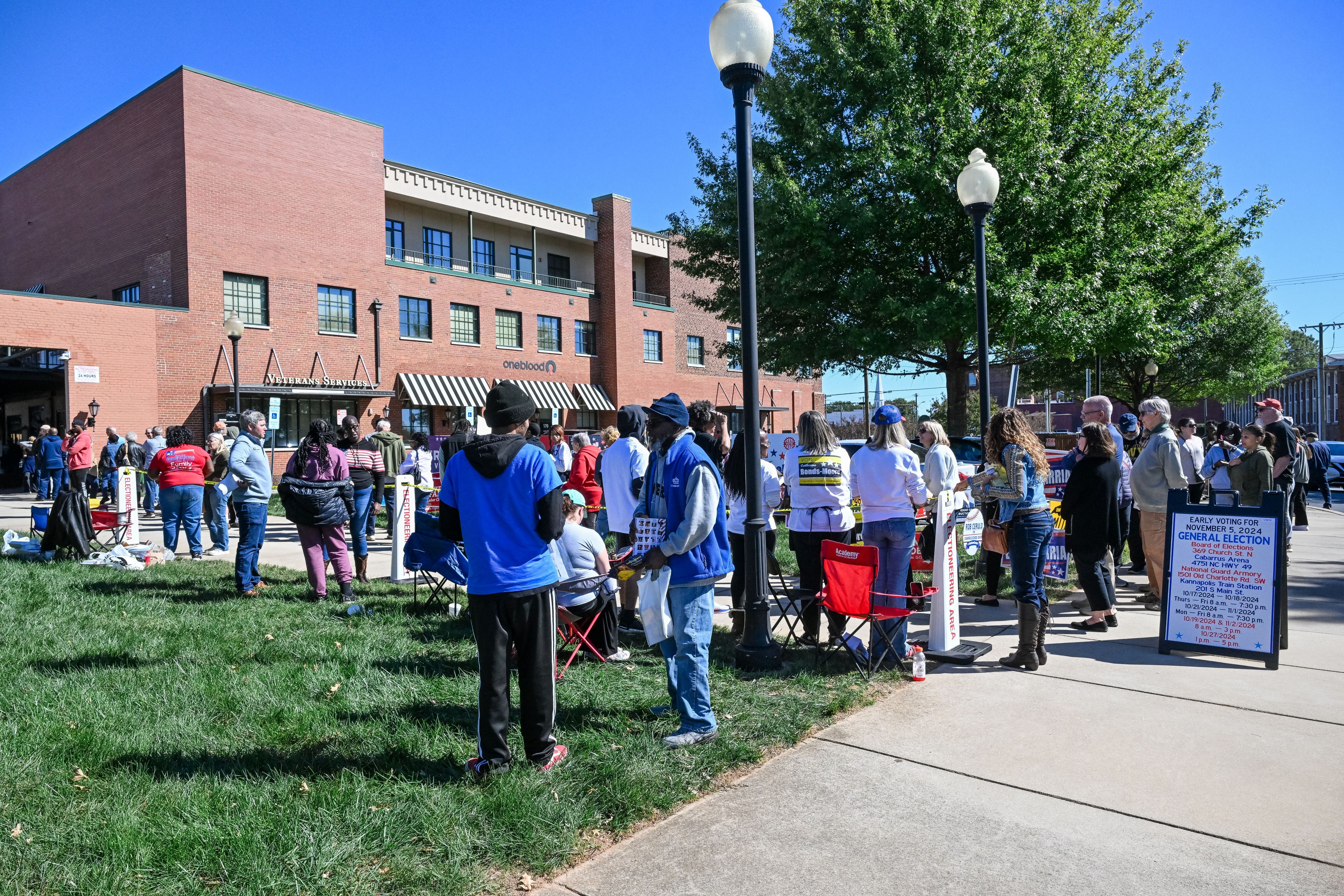
At long last, election season is officially upon us.
Early voting begins today in Cabarrus County, giving residents their first opportunity to cast ballots in an election that will determine who represents them in Raleigh, who helps lead county government and local schools, and whether to approve hundreds of millions of dollars in bonds for education and recreation projects.
From competitive races for the N.C. General Assembly, Cabarrus County Board of Commissioners and Board of Education to three proposed constitutional amendments, $400 million in school and community college bonds and a separate $40 million Kannapolis parks and recreation bond, voters have plenty of important decisions to make before Election Day on Tuesday, Nov. 3.
To help residents navigate it all, The Cabarrus Compass has put together this election primer, featuring early voting locations and hours, candidate profiles and a breakdown of the major ballot measures.
Early voting: When and where to cast your ballot
Early voting runs from Thursday, Oct. 15, through Saturday, Oct. 31, at four locations across Cabarrus County.
Voters may cast their ballots at any of the following sites, regardless of their assigned Election Day precinct:
Cabarrus EMS HQ Station 9: 793 Cabarrus Ave. W., Concord
Afton Ridge Active Living Center and Library: 6095 Glen Afton Blvd., Kannapolis
Cabarrus Arena and Events Center: 4751 N.C. Highway 49, Concord
Rowan-Cabarrus Community College at the N.C. Research Campus: 399 Biotechnology Lane, Kannapolis
Important: The Cabarrus County Board of Elections office is NOT an early voting location this year.
Early voting hours
All four locations will follow the same schedule:
Thursday, Oct. 15 – Friday, Oct. 16: 8 a.m. to 7:30 p.m.
Saturday, Oct. 17: 8 a.m. to 5 p.m.
Monday, Oct. 19 – Friday, Oct. 23: 8 a.m. to 7:30 p.m.
Saturday, Oct. 24: 8 a.m. to 5 p.m.
Monday, Oct. 26 – Friday, Oct. 30: 8 a.m. to 7:30 p.m.
Saturday, Oct. 31: 8 a.m. to 3 p.m.
There will be no Sunday voting.
Election Day is Tuesday, Nov. 3, when polls will be open from 6:30 a.m. to 7:30 p.m. Unlike early voting, voters must cast their ballots at their assigned precincts on Election Day.
All voters at early voting sites must show a photo ID, just as on Election Day.
To help voters plan their visit, Cabarrus County offers an online Wait Time Tracker that provides current estimated wait times at each of the county’s four early voting locations, along with operating hours and driving directions.
Voters can check the tracker before heading to the polls to see which locations have shorter lines.
The major competitive races
Voters will choose representatives for several important state and local offices, including three seats each on the Cabarrus County Board of Commissioners and Cabarrus County Schools Board of Education.
Below are the candidates in some of the election’s major competitive races, along with links to their Cabarrus Compass questionnaires.
NC House of Representatives – District 73
Incumbent Republican Jonathan Almond (view his Candidate Profile)
Democratic challenger Thomas Monks (Candidate Profile)
NC House of Representatives – District 82
Incumbent Republican Brian Echevarria (Candidate Profile)
Democratic challenger Chris Bishopp (Candidate Profile)
NC House of Representatives – District 83
Incumbent Republican Grant Campbell (Candidate Profile)
Democratic challenger Johnnie Jones
NC Senate – District 34
Republican Kevin Crutchfield (Candidate Profile)
Democrat April Cook (Candidate Profile)
Cabarrus County Commissioner (3 open seats)
Republican James Bailey (Candidate Profile)
Republican Commission Vice Chair Ian Patrick (Candidate Profile)
Republican Kristel Swayze (Candidate Profile)
Democrat Phil Henry (Candidate Profile)
Democrat Ingrid Nurse (Candidate Profile)
Democrat Dan Redding (Candidate Profile)
Libertarian Thomas Hill (Candidate Profile)
Cabarrus County Schools Board of Education (3 open seats)
Republican William Barbee (Candidate Profile)
Republican Bubba Hartsell (Candidate Profile)
Republican Dr. Robert Kirk (Candidate Profile)
Democrat Incumbent Pam Escobar (Candidate Profile)
Democrat Courtney Steinberg (Candidate Profile)
Democrat Mishell Williams (Candidate Profile)
After Election Day: Recounts and certification
Although Election Day is Nov. 3, the process of verifying and finalizing election results will continue in the days that follow.
Two important dates on the Cabarrus County Board of Elections’ post-election calendar are:
Wednesday, Nov. 11, at 10 a.m.: Sample hand-to-eye recount, a routine post-election audit in which election officials manually count ballots from selected voting locations or ballot groups to check the accuracy of machine-tabulated results.
Friday, Nov. 13, at 11 a.m.: County canvass, when the Cabarrus County Board of Elections reviews and certifies the county’s official election results.
Election night results are unofficial until the canvassing and certification process is completed.
Three proposed constitutional amendments
North Carolina voters will also decide whether to approve three amendments to the state constitution, addressing property taxes, income taxes and voter identification.
Unlike ordinary legislation, constitutional amendments change the state’s governing document and must be approved by voters before taking effect.
Here is a brief look at each proposal:
1. Property Tax Levy Limit Amendment
This amendment would require the N.C. General Assembly to enact laws limiting how much property taxes could increase.
A vote in favor would establish that constitutional requirement, while a vote against would leave the constitution unchanged.
2. Reduce Income Tax Rate Cap from 7% to 3.5%
This proposal would lower the maximum state income tax rate permitted under the N.C. Constitution from 7% to 3.5%.
The amendment concerns the constitutional ceiling on income tax rates, rather than directly setting the rate taxpayers currently pay.
3. Require Voter Identification Amendment
This amendment would expand the constitution’s voter identification requirement to cover all methods of voting, rather than only in-person voting.
It would extend the constitutional requirement for photographic identification to voters casting ballots through other methods, including absentee voting.
Cabarrus County school and community college bonds — $400 million
One of the biggest local decisions facing voters involves a proposed $400 million investment in educational facilities across Cabarrus County.
Voters will consider two separate general obligation bond referendums:
Up to $340 million for capital projects and improvements in Cabarrus County Schools and Kannapolis City Schools.
Up to $60 million for capital projects and improvements at Rowan-Cabarrus Community College.
The proposals are intended to address aging school buildings, enrollment growth, maintenance needs and demand for additional workforce training facilities.
County officials estimate that the two school districts face more than $1 billion in facility needs over the next decade, with the proposed bonds targeting some of the most pressing projects.
The last time Cabarrus County voters considered a general obligation bond referendum for school projects was in 2014, according to county officials.
General obligation bonds allow local governments to borrow money for major capital projects and repay that debt over time, generally using property tax revenue.
Approval would authorize the county to issue the bonds, rather than requiring all the money to be borrowed or spent immediately.
What would the bonds mean for taxpayers?
If voters approve both referendums, Cabarrus County would not borrow the entire $400 million at once. Instead, the county would issue debt as individual projects move forward, with the bonds repaid over 20 years through property tax revenue.
According to county estimates, a home assessed at $300,000 could eventually see an annual property tax increase of up to $150 if both referendums pass and the county ultimately borrows the full $400 million.
However, taxpayers would not see that entire increase immediately. County officials said the earliest a tax increase could take effect would be in fiscal year 2027-28, although an increase would more likely begin in fiscal year 2028-29, which starts July 1, 2028.
Cabarrus County maintains a AAA credit rating, the highest available, which allows it to borrow money at more favorable interest rates.
The county would also retain oversight of the bond proceeds, which could be used for eligible capital projects rather than day-to-day operating expenses.
Residents can estimate the potential impact on their own property tax bills using the county’s bond impact calculator.
Cabarrus County Schools
The largest proposed project for Cabarrus County Schools is an approximately $140 million replacement of Central Cabarrus High School.
The bond plan also includes $45.15 million for repairs and replacements at schools across the district, including HVAC and plumbing improvements, roof replacements and parking lot upgrades.
Among the proposed projects:
HVAC improvements: Bethel, Winecoff and Rocky River elementary schools.
Plumbing upgrades: Mount Pleasant Elementary.
Roof replacements: A.T. Allen and Patriots elementary schools, along with C.C. Griffin, Harold E. Winkler and J.N. Fries middle schools.
Parking lot improvements: W.M. Irvin and Weddington Hills elementary schools, W.R. Odell Primary and Harris Road and J.N. Fries middle schools.
The plan also includes conceptual design work for a future high school in southern Cabarrus County.
Kannapolis City Schools
Kannapolis City Schools would receive funding for two major expansion and renovation projects aimed at addressing aging facilities and enrollment growth.
A.L. Brown High School — Approximately $95 million
The largest proposed project would renovate and expand A.L. Brown High School, which was built in 1952 and serves nearly 1,700 students.
Plans include demolishing the structurally condemned Cannon Gym and constructing a new 50,000-square-foot facility with 16 classrooms, administrative offices and a new cafeteria.
The existing cafeteria would be converted into five additional classrooms, a dedicated JROTC drill area and specialized instructional space for the school’s Drone Technology pathway.
District officials say the improvements would help accommodate enrollment growth and ease overcrowding in the existing cafeteria, which seats only about 400 students at a time.
Jackson Park Elementary — Approximately $25 million
Another major project would expand Jackson Park Elementary, which is at capacity and houses a growing Spanish Dual Language & Global Magnet program.
Plans call for a two-story, 40,000-square-foot addition featuring 18 classrooms and a gymnasium, along with HVAC and roofing improvements and expanded parking and vehicle circulation areas.
Other maintenance projects
Additional improvements would include HVAC replacements at North Kannapolis, Jackson Park and Fred L. Wilson elementary schools; electrical upgrades at North Kannapolis; roofing replacements at A.L. Brown and Jackson Park; and parking lot replacements at G.W. Carver and Shady Brook elementary schools.
Rowan-Cabarrus Community College — $60 million
The second county bond referendum would provide $60 million for two projects at RCCC’s South Campus in Concord.
The largest is a $52.5 million Workforce Innovation Center, a proposed 70,000-square-foot facility designed to expand instructional space and meet growing demand for workforce training.
The remaining $7.5 million would renovate the S201 building, the first facility constructed on South Campus in 1990, to provide updated learning spaces.
For more information about the proposed projects and bond referendums, visit Cabarrus County Schools’ bond information page, Kannapolis City Schools’ bond information page or Cabarrus County’s bond referendum FAQ.
Kannapolis parks and recreation bond — $40 million
Kannapolis voters will also decide whether to authorize up to $40 million in general obligation bonds for a series of parks, greenways, athletic facilities and improvements to the historic Gem Theatre.
The referendum would represent the city’s first general obligation bond.
Kannapolis has not built a traditional park or new athletic fields in more than 20 years, according to city officials.
The proposed projects were identified through several years of planning, public surveys and community meetings. The city has already purchased properties for the proposed Eastside and Westside parks and completed their master plans.
What projects would be funded?
Eastside Park
A new 33-acre park on city-owned property along Midlake Road, with frontage on Lake Fisher.
Proposed amenities include a dog park, splash pad, walking trails, fitness stations, playground, picnic shelters, restrooms and paddleboats.
The city has received a $500,000 grant to help offset the project’s cost.
Westside Park
A new 55-acre park along N.C. Highway 73 (Davidson-Concord Road).
Plans include baseball and softball fields, multipurpose fields for soccer, football and lacrosse, playgrounds, picnic shelters, restrooms and access to the Rocky River Greenway.
Glenn Avenue Athletic Fields
Development of athletic fields and other passive recreation features on a 76-acre site.
Irish Buffalo Creek Greenway — Phases 2 and 3
The bond proposal would fund construction of two additional sections of the Irish Buffalo Creek Greenway:
Phase 2: Approximately one mile from Rogers Lake Road to N.C. Highway 3.
Phase 3: Approximately three-quarters of a mile from N.C. Highway 3 to Pine Street near Fred L. Wilson Elementary School.
The city has received a $245,000 grant to help offset greenway construction costs.
Rocky River Greenway
Additional greenway construction would extend west from the existing parking lot at Shiloh Church Road to the Mecklenburg County line and south from the current greenway endpoint to N.C. Highway 73 near the bridge.
Gem Theatre — Phase III Renovations
Improvements to the historic downtown Kannapolis theater would include expanded concessions, a larger lobby area and second-floor renovations.
What would the bond mean for taxpayers?
If approved, the city would be authorized to borrow up to $40 million in general obligation bonds over seven years, with the amount and timing of borrowing determined by the budgets and schedules of individual projects.
City officials say general obligation bonds would allow Kannapolis to take advantage of its strong credit rating to borrow at relatively low interest rates, while spreading construction over the next ten years rather than undertaking all the projects simultaneously.
The city says this approach would also help preserve cash reserves for emergencies and other unexpected expenses.
City officials have outlined a potential property tax rate increase of up to 4.6 cents per $100 of assessed property value over the next seven years to help pay for the bonds.
For a home assessed at $300,000, a 4.6-cent increase would translate to approximately $138 in additional property taxes annually.
The actual tax impact would depend on the rates ultimately adopted by the city.
According to city officials, the proposed parks and recreation projects would not move forward at this time if voters reject the bond referendum.
For more information about the proposed projects and the bond referendum, visit the Kannapolis Parks and Recreation Bond website.
Residents can calculate the potential impact on their own property tax bills using the city’s online bond tax calculator.
Before heading to the polls
Voters can review their individual sample ballots, verify their registration and find their Election Day polling place through the N.C. State Board of Elections.
For additional information about voting in Cabarrus County, visit the Cabarrus County Board of Elections website.
Whether you’re voting early or on Election Day, take some time to learn about the candidates and issues on your ballot.
And most importantly, make your voice heard. Get out and vote!