

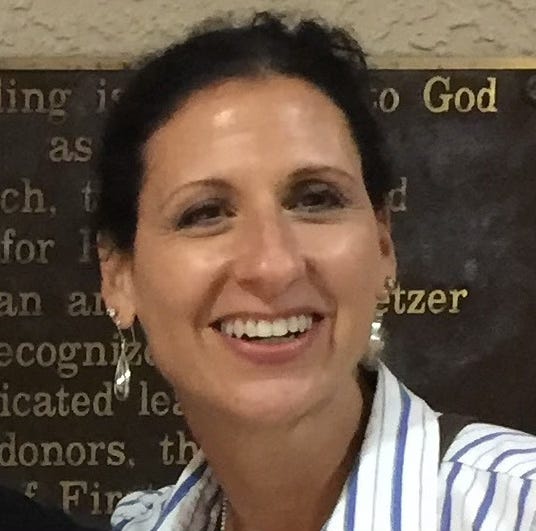
Deborah Allen is one of five Republicans running in the primary for three seats on the Cabarrus County Schools Board of Education. Here are her answers to questions from The Cabarrus Compass.
1. Please tell us about your background and your connection to Cabarrus County Schools. Do you currently have, or have you previously had, children enrolled in the district?
In 2016 I retired from teaching after 32 years in education. I began my career as a teacher of children with special needs. After 14 years, I gave up tenure in that area and moved into general education. I acquired a Master's Degree and two certificates, one for a school district administrator and one for school supervision. I mentored new teachers and was the chief building representative.
Since then, I have been a substitute teacher and have been working in Cabarrus County Schools. The middle schools have been my primary focus since that has been where most of my previous experience has been. Our two children are grown and live up north with our three grandchildren and one on the way.
2. What motivated you to run for the Cabarrus County Schools Board of Education, and do you have any prior experience in elected office or public service?
I do not have any prior experience in elected office, but have dedicated my life to public education. The motivation for me to run for Cabco School Board is to bring an excitement for learning back to student life, and to return a level of respect and professionalism back to teachers.
It is my hope that parents will become more involved and a true partnership will be made with parents and teachers. We must recognize the responsibility every community has to protect families and to foster responsible growth.
3. What qualifications, skills, or experiences best prepare you to serve as a school board member?
The qualifications are my over 40 years of serving in different capacities in schools. I have taken numerous leadership courses and have interned in my home school district as an assistant principal and as a district supervisor. I have written a school handbook for parents and have mentored student teachers.
I have attended numerous school board meetings as well as county commission meetings. I have mentored new teachers and have acted as a building union representative and attended many school conferences. In addition to these credentials, I am a wife, mother, and grandmother. My life experiences have prepared me for this time.
4. Is there a specific issue or set of concerns within public education that most motivates you to seek a seat on the Board of Education?
The concerns that have brought me to this place to serve on the Board of Education are school policies that have come down from New York State in the form of national policies brought about from "No Child Left Behind." Since that time, education has become too political, and control for schools has been overtaken by PACS that have taken money and control away from the local community and into the hands of bureaucrats.
There is too much administrative bloat and policies that need to be reviewed and changed. I would like to see more decisions made at the local level and for schools to not be micromanaged from national oversight and ownership. Parents must have their rights restored and be made aware of what their children are being taught.
5. How do you define equity and inclusivity in public education, and what steps would you support to ensure all students have the opportunity to succeed?
Equity has been available through the Equal Opportunity Act which paved the way for the EEOC. This Act made it illegal to discriminate based on race, religion, sex, or national origin. This extended Title VII protections to state, local, and educational institutions. This means that public education must provide a sound education for all children.
As far as teachers and staff, the same opportunities should be applied to them in that when hiring, we must seek the most qualified staff without discrimination. I believe in opportunity for all families who strive for lawful and respectful relationships in our community.
6. What role should parents play in decision-making at the school and district level, and how would you work to improve communication and trust between families and Cabarrus County Schools?
Parents are the first line of defense for their children. Other than online surveys through Parent Square, I would like to see town meetings set up at least three times a year where parents are invited to discuss areas of concern and where they are heard and responded to.
As of now, parents only come out to School Board Meetings to the Awards Ceremony and then leave. Parents do not feel welcomed into the decision-making process because they do not feel listened to. We need to make a greater effort to communicate at a face-to-face level, and stop talking at them, or worse, down to them.
7. In your view, what are the most significant issues currently impacting students and parents in Cabarrus County Schools, and why?
The significant issues that impact students and parents are how fast and how much the county is growing. As we grow, we have not done enough to maintain the small-town feel that our community has been known for.
In addition, the redistricting of our schools have broken up neighborhoods and forced some students to have to travel across town to attend school. We can do better to keep students together. We must consider who lives here now. We need to grow in a smart and sustainable way.
8. If you could make one immediate change within the school system, what would it be and what impact would you expect it to have?
One immediate change we can do now is to effectively use school administrators to enforce the discipline policy so that teachers can teach and not carry the burden of discipline in stopping for the one or two disruptive students.
Our classrooms need to be places of academic learning where students understand the limits and adhere to the rules. Teach self-discipline and raise the expectation of rigorous learning.
9. How would you approach balancing academic performance, student well-being, and fiscal responsibility when making decisions as a school board member?
When we have a budget, we can allocate resources based on needs, not wants. Money is not the only answer to excellence. Fiscal allocation of funds and an atmosphere that respects education is.
10. School board members often face disagreements on policy and priorities. How would you approach conflict resolution and collaboration among board members?
Through respectful dialogue knowing that we can agree to disagree. We all must give and take to come to a mutually agreeable solution.
11. Individual board members have no independent authority, as decisions are made collectively. What personal traits or skills would allow you to contribute effectively to the board as a whole?
I have learned what I have taught which is effective listening skills. A strong leader knows how to delegate authority and when to listen and when and how to speak. I take copious notes. I reflect on every meeting. I try to understand every person regardless of differences. I can also admit when I am wrong. I try to walk in humility.
12. After your first full year in office, what benchmarks or outcomes would you point to as evidence that you have made a meaningful impact?
After one year, I would like to see a greater attendance of parents at School Board Meetings and a greater involvement of parents in the educational process. I also would like to see students who are graduating and those students who have made continued academic progress in reading and math.
Your answers are spot on!