

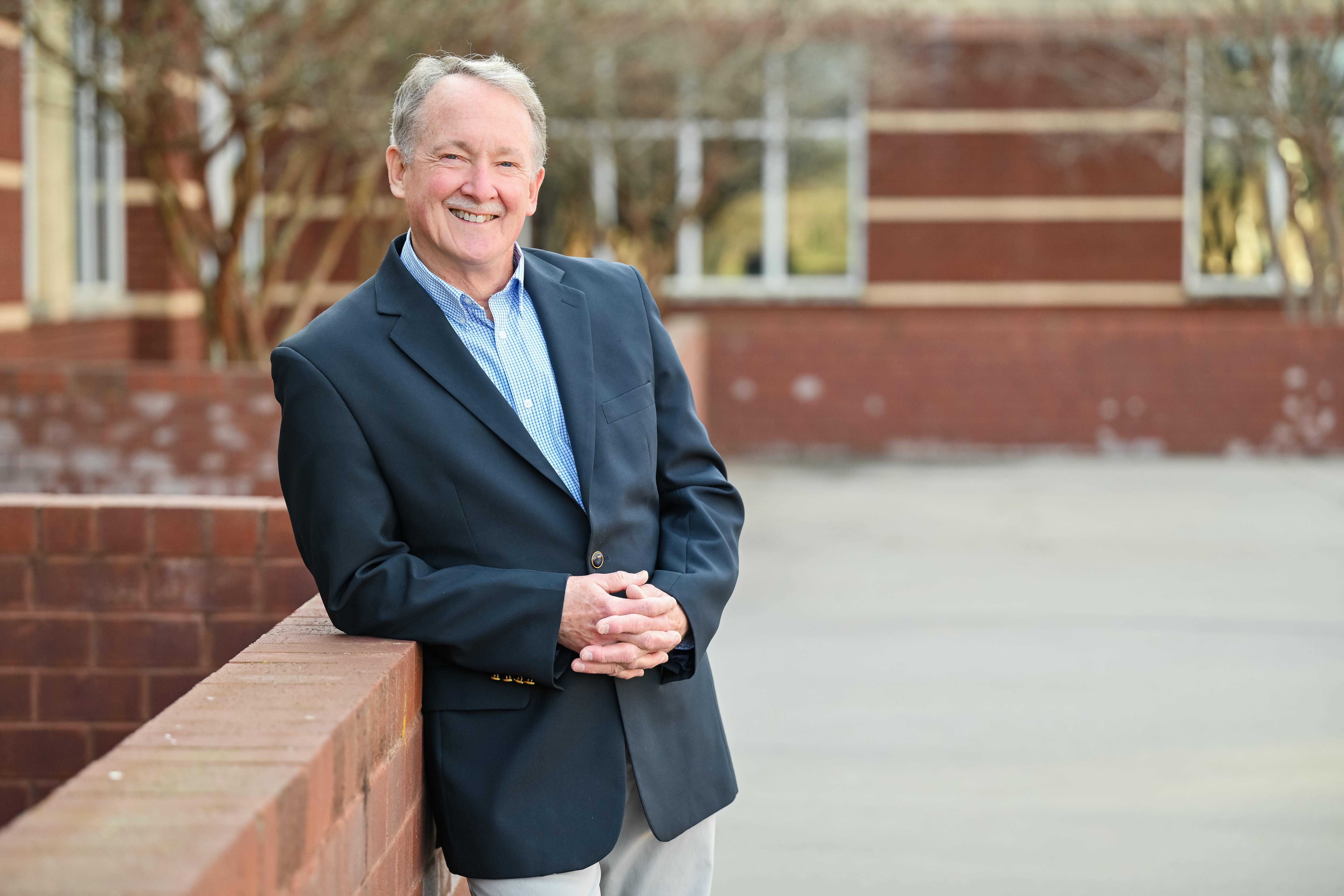
Dr. Robert Kirk is one of five Republicans running in the primary for three seats on the Cabarrus County Schools Board of Education. Here are his answers to questions from The Cabarrus Compass.
1. Please tell us about your background and your connection to Cabarrus County Schools. Do you currently have, or have you previously had, children enrolled in the district?
Though born in the U.S., I grew up in Brazil – bilingual and bicultural - until my senior year in high school when my parents moved to Knoxville, TN. My first two years in college were at Mars Hill College, NC, followed by my enlisting in the US Navy’s Nuclear Power Program, becoming an instructor in the community. Through an officer ascension program, I completed my B.S. in abstract mathematics at Auburn University, AL. Retired after 20 years in the US Navy, worked in private business for 10 years, then moved to Concord, NC, in 2001.
Cabarrus County Schools employed me in 2002 as a Math Teacher at J. M. Robinson High School, where I served as both Math Teacher and Dropout Prevention Coordinator. Following that introduction to a structured classroom experience, I was asked to serve as Assistant Principal at the Glen Center followed by Principal at the same school that housed seven CCS entities on the campus.
Superintendent Dr. Barry Shepherd invited me to be Chief of Staff, where I served for approximately seven years, overlapping with Dr. Chris Lowder when he became Superintendent. Total time with CCS about 16 years.
I do not have, or previously have had, children in the district.
2. What motivated you to run for the Cabarrus County Schools Board of Education, and do you have any prior experience in elected office or public service?
Cabarrus County Schools are top notch, and I want to help grow it “from good to great” (thank you Jim Collins!). My desire is to bring my own skill sets acquired through experience during my military career, through private sector leadership, as a classroom teacher, in district-wide educational leadership, engagement with previous Board of Education service, through public service, and non-profit leadership – all to strengthen our existing Board and make it even stronger.
These aspirational goals are framed by educational knowledge and hands-on experience within Cabarrus County Schools - all derived from years of community engagement coupled with formal, graduate level education.
While I have no experience in elected office, my life has been directed to serving: 20 years in the US Navy, 16 years with Cabarrus County Schools, three years with West Cabarrus YMCA, and through service-centered organizations such as 20 years with the Rotary Club of Cabarrus County, supporting Meals On Wheels, American Red Cross, Present Age Ministries, and other non-profits.
3. What qualifications, skills, or experiences best prepare you to serve as a school board member?
Years of leadership under my belt: retired military officer, business General Manager, educator, and Dream On 3 Director of Growth and Expansion, which called for leading Advisory Boards in GA, CO, NC, VA, DC, TX.
The greatest experience was serving as Chief of Staff for CCS, enabling me to be present for all the Board of Education’s closed and open sessions spanning many years.
4. Is there a specific issue or set of concerns within public education that most motivates you to seek a seat on the Board of Education?
My heaviest concern is our society’s political polarization which has inserted itself into the educational arena. Boards of Education members need to keep their eyes on the student, teachers, and staff.
5. How do you define equity and inclusivity in public education, and what steps would you support to ensure all students have the opportunity to succeed?
Equity translates into students receiving the support they each need to succeed – it differs from equality where every student receives the same thing. In a society as rich as ours, the students we serve are varied in culture, physical and mental capacity, and language skills.
We must steer clear of providing a cookie-cutter solution to the equity and inclusivity challenges. Our classroom teachers are the difference-makers: their mission is to understand their classroom students, understand where they are in terms of a knowledge base and methods of learning, and meet them where they are. We call that “scaffolding,” and build upon this wisdom to ensure equity and inclusivity is not just a slogan.
Cabarrus County Schools understands that this can only happen with well-trained educators and our system does an excellent job of providing continuing education to help our teachers “sharpen their saws” (thank you Stephen Covey!).
6. What role should parents play in decision-making at the school and district level, and how would you work to improve communication and trust between families and Cabarrus County Schools?
Parents engagement is key to the success for any school system, and when their voices are heard, everyone benefits. The question is a great one, as parents need to not only focus on their student, but plug into the local parent teacher organization.
The added dimension of the question requires parents to know what policies are in place already, what issues are facing our 44-schoolhouse-system, and to gain an appreciation of district-wide concerns. Whether attending the bi-monthly school board meetings in person or online, or supporting local community forums, parents gain a stronger voice when they are educated on what decisions need to be made.
Improving communication calls for transparency on the part of the school board and delivering on decisions made. Becoming school system advocates and supporters builds such trust, communication flow, and credibility between parents and the Board.
7. In your view, what are the most significant issues currently impacting students and parents in Cabarrus County Schools, and why?
Managing Growth & Capacity
Address overcrowded schools already at or exceeding design capacity
Plan and build new schools (next elementary school scheduled for Fall 2028)
Consider enrollment caps
Strategic land acquisition for future schools (50-100 acres per school type)
Deferred Maintenance Crisis
Address $250 million in deferred maintenance across district facilities
Shift from costly corrective maintenance to preventive maintenance
Teacher & Staff Retention
Improve compensation and appreciation for educators
Ensure all employees feel seen, known, and valued
Address talent loss to other districts
Governance & Accountability
Maintain strong relationships with County Commissioners and Local Government Commission
Ensure transparent accountability from schools to Board to community
8. If you could make one immediate change within the school system, what would it be and what impact would you expect it to have?
Recommend the elimination of CCS policy that allows students to re-test if they score less than 80% on a formal assessment. This requires teachers to generate different versions of each test, requires teachers to provide additional remediation to students and requires extra time in grading coupled with the administrative burden in documenting multiple grades for the same event, and the increase in teachers’ already lengthy workday.
This undermines the very effort of increasing teacher morale, retention, and recruitment and shifts the responsibility for learning from the student to the teacher. Students are not seeing a need to prepare well for a formal assessment when they know a retest must be provided. It also does not prepare high school students for the rigor of college, work force, or the military.
9. How would you approach balancing academic performance, student well-being, and fiscal responsibility when making decisions as a school board member?
Cabarrus County Schools exists to educate our student population. There appears to be a mounting concern that our students are losing the edge in their ability to think and appear to be abdicating their responsibility to be educated.
Yes, we want our students’ well-being to be part of the equation, but not at the cost of curricular rigor, which drives academic performance and student readiness for what follows their graduation year.
Fiscal responsibility is what frames our legal mission: educate our students. If our pursuit of student well-being colors outside this framework, we are guilty of poor stewardship of those funds allocated to our schools by local and state government.
10. School board members often face disagreements on policy and priorities. How would you approach conflict resolution and collaboration among board members?
Boardsmanship is a team sport! Of tremendous value to the processes of our CCS Board of Education is the structured and schedules closed session meetings during which time such differences are openly discussed.
When the end game for any decision is filtered through the lens of what is best for students, teachers, and staff, the give-and-take of differences allow for a hammering out of consensus. Once consensus is reached, the Board provides a unified message to the community.
Any appearance of lack of civility and open discord does not build trust and confidence among the public the Board serves.
As is true with any group of people, camaraderie allows for differing views and invites open discussion and sharing of ideas. Conflict resolution starts with identifying the end game, assessing where the differences lie, and working towards bridging the divide.
11. Individual board members have no independent authority, as decisions are made collectively. What personal traits or skills would allow you to contribute effectively to the board as a whole?
I draw upon the standing rule our indigenous population here in the US held when entering tribal council meetings: withhold certainty. While I do hold strong opinions, I also am a listener to what others have to say, that I may learn from others in the room. I feel I am a consensus builder and while Board members need to express differing opinions among themselves, they need to present a united front on significant issues.
12. After your first full year in office, what benchmarks or outcomes would you point to as evidence that you have made a meaningful impact?
1. A zero-base budget review to assess where existing CCS funds are being directed.
2. An assessment of teacher morale, and the numbers to support increased teacher retention and recruitment.
3. A codified strategy for increasing schoolhouses to accommodate growing student population.
Robert has the experience and Knowledge / he has been and an administrator.I believe he is the only candidate to address TEACER MORALE. I worked in public education for 30 yrs and my wife taught 8th grade for 25 years. Teaching can be rewarding but you can get beat down because of a lack of discipline in your class and the entire school Cabarrus County Schools has a very good reputation which is well deserved because of the excellent teachers and administrators.My point is i would like for our schools to be known for outstanding behavior standards. This can mean that we hire more staff for in school suspension guidance counselors and specialist.These steps would cost money but our students ,staff , the public and parents deserve this atmosphere and standard.
Having these expectations will transfer to better and happier students.
Teachers deserve so much more pay. This poor condition is caused by legislators who brag about lower taxes and starve the public schools , I would like to see our future school board devote much more energy to this subject.We get what we expect.
Robert can be one of the members to treat this issue seriously.