

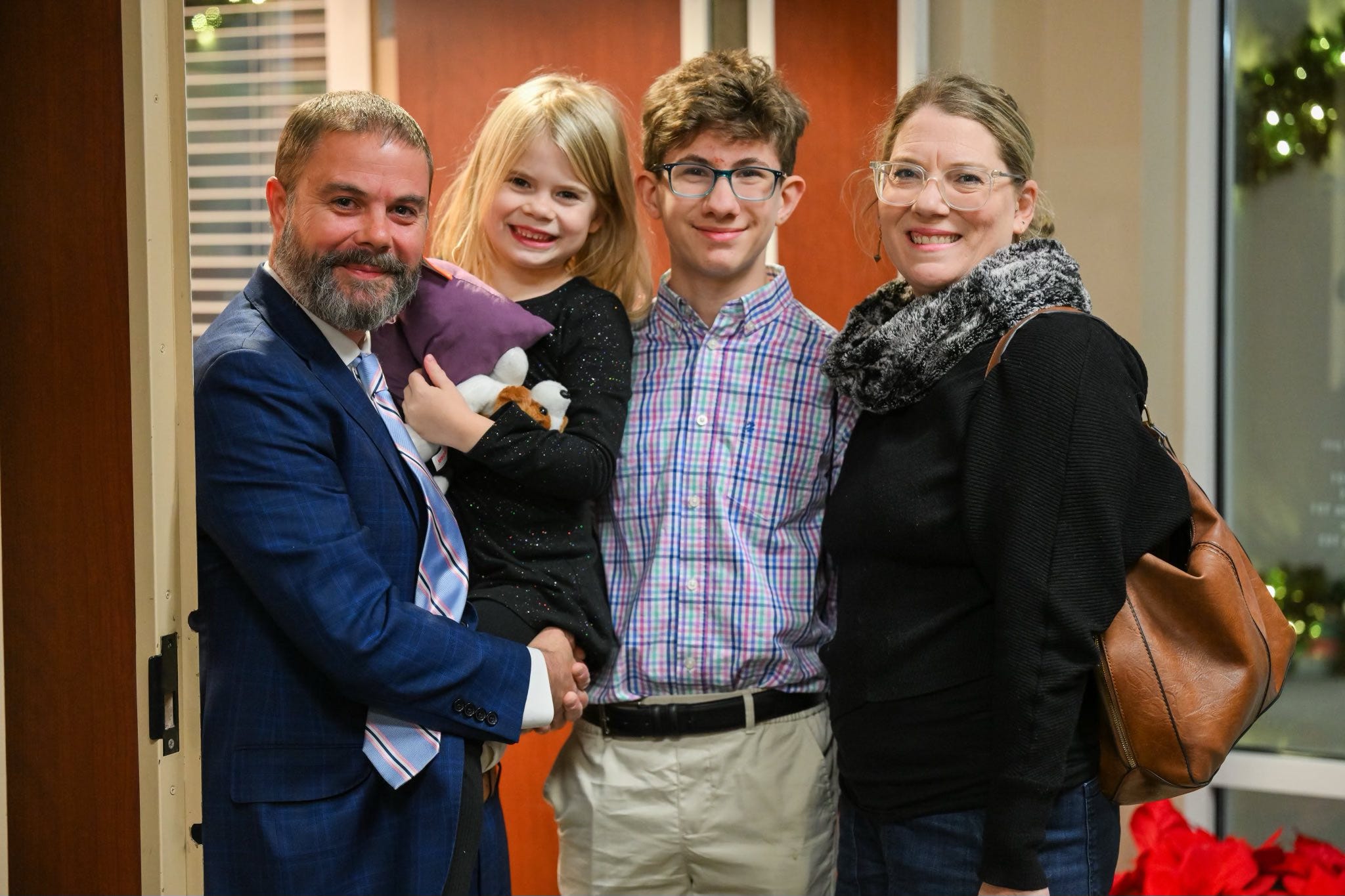
Ian Patrick, a sitting county commissioner, is one of eight Republicans running in the primary for three seats on the Cabarrus County Board of Commissioners. Here are his answers to questions from The Cabarrus Compass.
1. Please tell us about your background and your connection to Cabarrus County. How long have you lived in the county, and what ties do you have to the community?
I was appointed to the Cabarrus County Board of Commissioners in December 2025 by the Republican Party, with a unanimous vote from the Board, and was subsequently elected Vice-Chair (again unanimously). I previously served two terms on the Harrisburg Town Council, where I also chaired the Board of Adjustment.
I moved to Cabarrus County while attending UNC Charlotte, where I earned two degrees in architecture and met my wife, Erin. We married on July 4, 2011, and have two children, ages 15 and 6. Together, we own an architecture firm that employs nine people.
My community ties include membership in the Cabarrus Chamber, the NC Economic Development Association, the Construction Professionals Network, and SCUP (Society of College and University Planners). I am a certified disaster relief inspector for NC SEER, working with FEMA after natural disasters to ensure buildings are safe for re-occupancy. I am LEED Certified in Building Design + Construction and have served as Vice-Chair and Membership Committee Chair for that board.
I also served on the American Institute of Architects’ Legislative Review Committee and am a registered architect in North and South Carolina. In 2022, I received the prestigious Charlotte Business Journal’s 40 Under 40 award and a CPN Service Award.
2. What motivated you to become involved in public service and to run for the Cabarrus County Board of Commissioners at this time?
When I first ran for Harrisburg Town Council, I was responding to a council that wasn’t listening to residents. They were approving residential developments at an alarming rate - so quickly that one public hearing had to be moved to a local school to accommodate the huge crowd. The council approved it anyway.
I also witnessed them awarding a $500,000 contract for a construction manager on a simple park project. As an architect, I knew that wasn’t necessary; construction managers are typically reserved for highly complex or time-sensitive projects - this was neither. I spoke against it, but they approved that too.
During my time on the council, we made major changes correcting past mistakes, reducing residential approvals by 96%, adding a full Division to the Sheriff’s office, and lowering taxes - all while delivering better results for residents.
Now, as a Cabarrus County Commissioner, I share similar goals: reducing spending, cutting taxes, and strengthening public safety. With only about a year left in my appointed term, however, there’s not enough time to deliver the lasting changes residents deserve. Government is slow, and for good reason, but I need at least 5 years to effect change. That’s why I’m running for a full term.
3. What qualifications, skills, or experiences do you believe best prepare you to serve as a county commissioner?
In addition to my two terms on the Harrisburg Town Council and my current service as a Cabarrus County Commissioner, my background as an architect and business owner gives me a unique perspective for public service.
Architects are trained to solve complex problems, consider the big picture, weigh options carefully, and propose creative yet practical solutions. In other words, thinking outside the box. Understanding how development is planned, negotiated, and executed equips me to make informed decisions that truly benefit our community and drive positive change.
4. What role do you believe county government should play — and should not play — in economic development, land use, and public-private partnerships?
As Chairman of the Board for CPNI (Construction Professionals Network Institute), a nonprofit, I help lead free workshops for struggling rural towns across North Carolina. Many of these communities suffer from lost industry as companies move operations overseas. We provide professional expertise to help them attract new economic opportunities.
Cabarrus County has the opposite problem. We’re booming so rapidly that our schools and infrastructure are struggling to keep pace. I recently rewrote the County’s economic development policy to return more decision-making authority to the Board, meaning to the people, where it belongs.
Government can negotiate targeted incentives for businesses that create meaningful jobs and opportunities for residents, but that shouldn’t be its primary role. Organizations like the Chamber of Commerce, funded privately, are better positioned to recruit businesses.
The county’s job is to maintain a stable, predictable environment so the private sector can thrive. Above all, government should simply get out of the way and let the private sector do what it does best.
5. In your view, what are the most significant issues currently impacting Cabarrus County residents, and why?
The most pressing issue is our projected budget shortfall: $13.7 million for FY27, growing to around $27 million by FY28 and a staggering $67 million by FY31. This is unsustainable. With a budget approaching half a billion dollars, shortfalls like this are unacceptable.
In the coming months, my focus is on passing a realistic, balanced budget. Once that’s achieved, I’ll prioritize reducing the tax burden on hardworking families and ordinary residents in future years.
6. According to the U.S. Census, Cabarrus County’s population has grown from approximately 178,000 in 2010 to about 250,000 today. How would you approach managing continued growth while preserving quality of life for residents?
It is not the farmers in the County causing this growth – it is the municipalities. In Harrisburg, we responded to resident concerns by reducing new residential approvals by 96%, giving infrastructure time to catch up.
We need stronger collaboration with municipal leaders to rein in unchecked growth. Terms like “smart growth” are often used – a meaningless term. Elected officials should listen to what residents actually want and act on it - they’ve made their voices crystal clear, but elected officials don’t seem to be listening.
I would show the municipalities how to rewrite development ordinances (as we did in Harrisburg) or re-map zoning districts to permit only the growth residents support. Growth isn’t inherently bad, but when municipal decisions strain County-funded schools, with no direct accountability for those costs, it’s unfair.
The County alone pays for school facilities, so residents who simply want to be left alone shouldn’t bear the burden of uncontrolled expansion they didn’t want and certainly didn’t ask for.
7. What do you see as the county’s most urgent infrastructure or capital needs over the next several years, and how should these needs be addressed?
Schools, schools, and schools. State law requires the County to fund school facilities, yet we’re facing substantial budget deficits. The best approach is to put bond referendums directly to voters on the ballot: Do they want to approve bonds for new schools? If voters say no, the school system must adapt accordingly. I think the voters are smart, but they’ve been treated in the past as if they are not.
8. If elected, which area or function of county government would you prioritize for increased attention, and what specifically would you hope to improve?
Efficiency. Our County has one of the highest per capita number of employees compared to our peer groups. As a business owner, I know that pursuing efficiencies reduces costs and improves outcomes – but for some strange reason the government doesn’t even try to operate this way.
I would direct the County Manager and department heads to review policies and procedures, ensuring that legally required functions are performed as efficiently as possible while eliminating waste. Being a responsible steward of taxpayers’ dollars should never be an afterthought.
9. What is one decision or action taken by the current Board of Commissioners that you believe was handled well, and one area where the board should improve?
As a sitting Commissioner, I'm proud of the $3 million in savings we're set to achieve by switching insurance brokers. It was evident the previous approach was broken, and we fixed it decisively.
I can replicate this kind of results-oriented change across departments. By empowering capable staff, major benefits for residents can be realized while reducing costs – and therefore taxes in the long term.
10. Do you support maintaining current tax rates, lowering them, or making changes to the county’s tax structure? Please explain your position.
I support lowering taxes. Too many people misunderstand government's core role. Government should handle essential functions the private sector can't - public safety (police and fire), courts, the basics - and provide a stable, predictable environment for businesses and families to thrive.
Government shouldn't pick winners and losers; it should simply get out of the way and let the private sector grow, create jobs, and expand the tax base naturally.
11. County budgeting involves difficult trade-offs, and projections show a roughly $13.7 million deficit in FY 2027. If elected, how would you approach setting spending priorities, evaluating potential reductions or revenue options, and closing the projected deficit while maintaining essential county services?
Through efficiencies and eliminating waste, something my business does routinely and we achieved in Harrisburg (where we maintained one of the lowest per-capita costs among peer cities). In business, you invest in top talent and support them well; it may seem counterintuitive because it involves higher upfront compensation, but the best people can accomplish the work of three people, repaying that investment many times over.
We'll prioritize essential services like public safety and schools while ruthlessly eliminating waste and redundancies. This approach closes gaps while lowering taxes without cutting core functions.
12. If elected, what would be your top priorities during your first year in office, and how would they align with your approach to budgeting and financial management?
My top priority is getting our fiscal house in order. We’re currently spending more than we take in - an approach that would bankrupt any private business, including my architecture firm. Once we’ve balanced the budget, we can focus on supporting employees in ways that enable them to serve residents more effectively and more economically.
Beyond that, my approach is straightforward: get government out of the way, let private industry drive economic growth, create jobs and opportunities, expand the tax base, and deliver essential services at the best possible value - without venturing into areas government has no business entering.